From Trigger to Agent: Why Marketing Automation Is Taking a Significant Step Forward

On 11 November, I had the opportunity to speak at the IKM Impuls at Lucerne University of Applied Sciences and Arts about a topic that has been occupying my thoughts: What happens to marketing automation when AI moves beyond creating content or making recommendations and starts making decisions itself?
Interest was greater than expected: just over 100 people registered for the session. What I found even more interesting than that number was the discussion afterwards. Surprisingly few questions concerned which AI model is currently the best. Far more were about data, processes, data protection, responsibility and the practical question: Are we, as a company, ready for this at all?
Marketing automation is established. But rigid.
I have worked with marketing automation for many years. To make one thing clear at the outset: it already works quite well today.
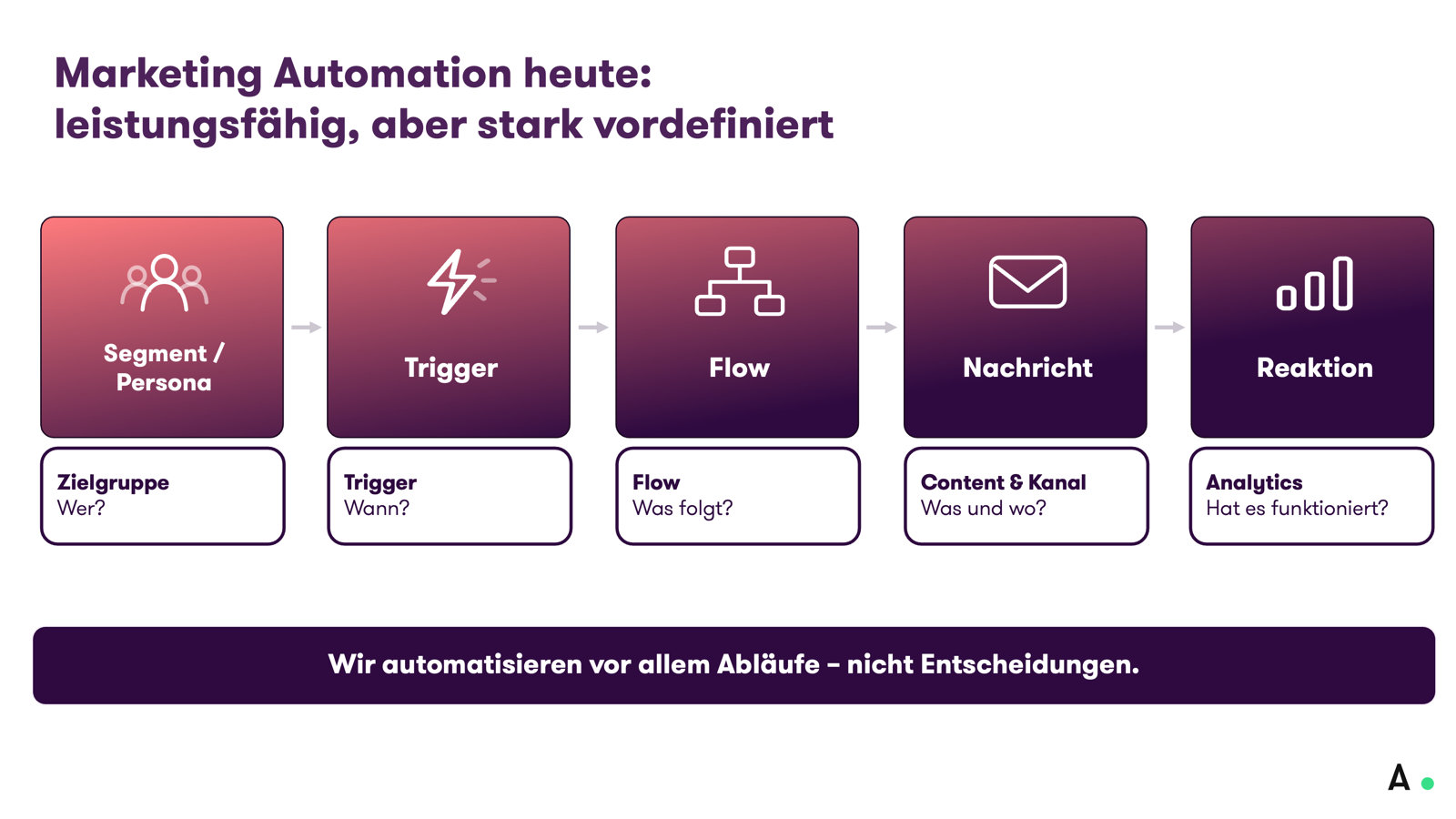
The logic is usually relatively simple: we define a target group or persona, a trigger occurs, a flow starts, a message goes out through a defined channel, and we then measure the response. Put even more simply: if X happens, do Y.
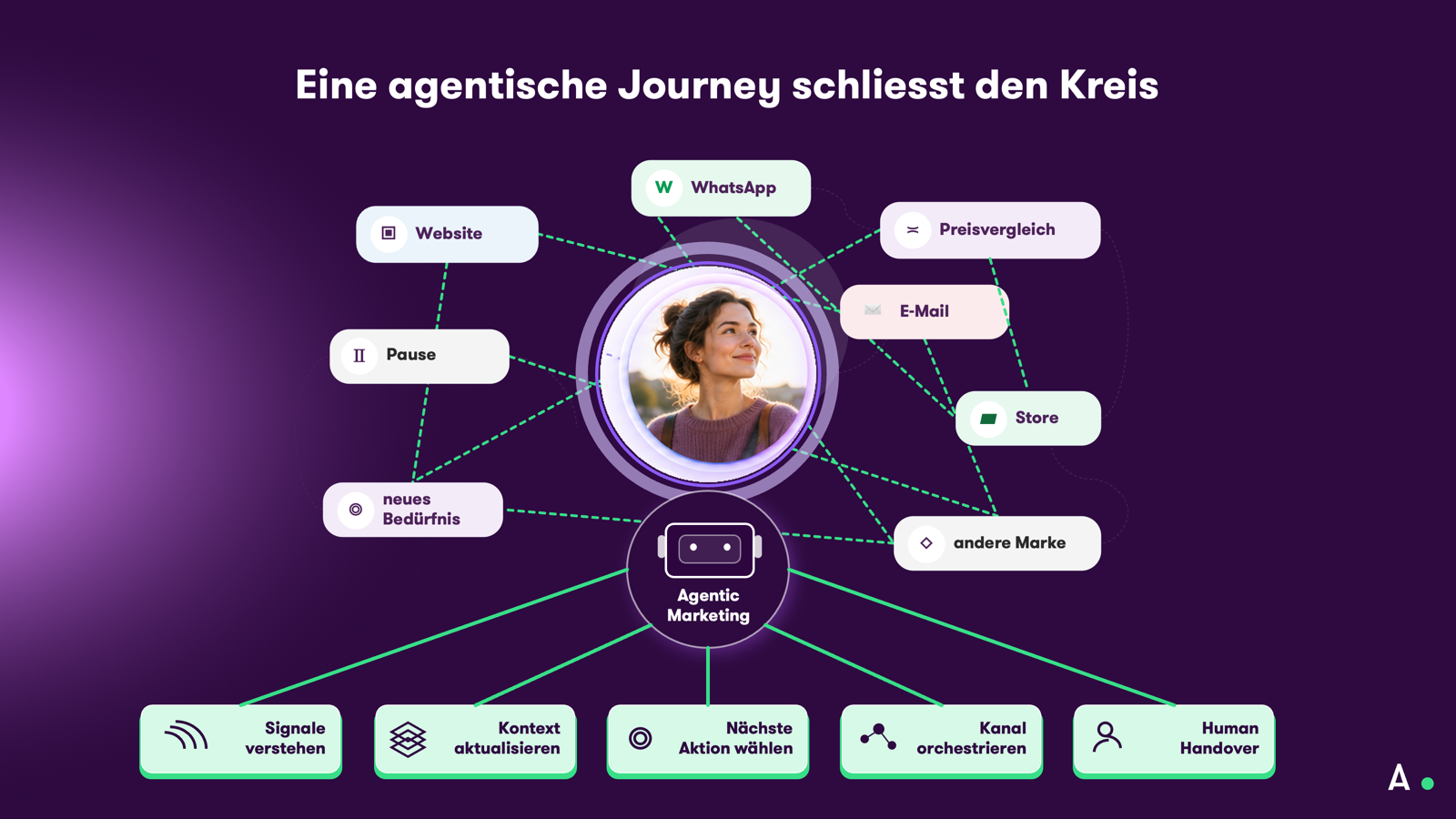
This is effective, reasonably scalable and now established in many companies. The problem is that the customer has no interest in our flow. They visit the website, take a two-day break, ask a question via WhatsApp, compare prices, speak to someone in a shop, leave an e-mail unopened and, three days later, may already have a different need.
The harder we try to map this reality with classic automation, the more segments, rules, conditions, exceptions and variants we create. We can do that, but it quickly becomes time-consuming. To put it bluntly: today, we are very good at automating sequences, but we still automate decisions relatively rarely.
This is where it becomes agentic
For me, the decisive difference with agentic AI is therefore not that a language model has been built in somewhere. A process becomes agentic when every individual step is no longer defined in advance.
Instead of “If the customer does X, send message Y”, the logic becomes more like: “This is our goal, this is what we know about the current situation, and these are the actions that are permitted. Decide which next step makes sense now.”
That may sound like a small change, but it is not. Automation increasingly shifts from executing predefined sequences to automating decisions.
An agent might, for example, recognise that a person needs advice rather than another marketing e-mail. It can ask a follow-up question, choose a different channel, identify missing information or decide that the time has come to hand over to a person. We no longer have to model every possible variant of the journey in advance.
Agentic AI does not mean autopilot
This point was particularly important to me in the talk. When we speak of “autonomous agents”, it is easy to picture an AI roaming through a company independently and making decisions. I think that is the wrong perspective.
In my view, a useful agent needs five things: a clear goal, context and data, a model to interpret that information, tools or access to systems and actions, and guardrails defining what it may do, what it may not do and when a person must take over.
Autonomy therefore does not emerge from removing rules. On the contrary: the more an agent is allowed to do, the more clearly its goal, scope for action, permissions and escalation logic must be defined.
For me, this is one of the most important points in the sometimes rather euphoric discussion about AI agents. The aim should not be to create as much autonomy as possible, but to define the right autonomy for a specific process.
And no: this is not a distant prospect
In the talk, I deliberately showed examples that are already in production or at least being used in real pilots.
For the South African shopping platform Bash, Bloomreach reports a 35.2 per cent higher conversion rate and 39.8 per cent more revenue per visit among users who interacted with a shopping agent. In a Salesforce case study, Nestlé reports that an agent autonomously resolved 40 per cent of enquiries in a consumer service pilot. The reported customer satisfaction score was 4.8 out of 5.
An example I am particularly proud of comes much closer to home. Together with FREI’S Schulen, we at Arcmedia implemented a lead generation system that identifies training needs, matches prospective students with suitable offers and accompanies them through to an information event. In just four days, it generated 691 qualified leads, with an opt-in rate of 53 per cent.
The technology is real. It is being used and is beginning to develop from simple chatbots into participants in business processes. At the same time, I would treat all these figures with some caution. Many of the case studies available today come from technology providers or individual pilots. Different use cases, measurement methods and starting points make direct comparisons difficult. What matters, therefore, is less whether someone achieved 30 or 40 per cent more conversion somewhere, and more that we can now see the technology working in practice and taking on real tasks.
The real challenge often lies outside the AI
One question from the audience was, in essence: Where do companies have the most work to do today? My answer was: in the context.
Companies have a great deal of knowledge, but it is often scattered. Some is in the CRM, some in the ERP, product information is in the PIM or CMS, service knowledge is in documentation, and a surprising amount still exists only in employees' heads.
For a person, this works surprisingly well, because we simply ask someone. An agent cannot do that. It needs access to information and must be able to determine which information is relevant and reliable. Even the most capable language model therefore cannot compensate for poor data, missing product information or unclear processes.
In my view, this is a central aspect of what is called agentic readiness. Over the long term, data, systems, processes and governance have a greater influence on the value created than the question of which model is being used.
Readiness should not become an excuse
If companies demand perfect data, a fully integrated CRM, a customer data platform, AI governance and a completely developed AI strategy before trying anything, many will never start.
For me, readiness is therefore not a state we eventually reach. It also develops through experimentation. A clearly bounded pilot often reveals the real problems very quickly. Perhaps data is missing, perhaps the process is less clear than everyone thought, or perhaps responsibilities have not been settled. The opposite can happen too: the use case works surprisingly well even though the technical starting point is far from perfect.
A first attempt therefore does not necessarily require a huge technology programme. A well-structured data source can be more valuable for a pilot than a complex but poorly maintained system. In the discussion, I deliberately pointed out that a first use case does not have to begin with a perfectly integrated CRM or a CDP. Depending on the task, even a well-structured Excel file can provide enough context for an initial test.
Where would I start tomorrow?
Not with autonomous price negotiations, not with contracts, and probably not with goodwill decisions that have financial implications. I would look for processes that occur frequently, are relatively clearly bounded and in which an error remains manageable.
Lead qualification is a good example. An agent can interpret the information in an enquiry, ask for missing details, assess the lead and recommend a next step, while a person initially confirms the decision. The same applies to frequent service questions, reactivation, simple product recommendations or preparing a sales handover. As experience grows, the scope for action can be extended step by step.
Controlled evolution rather than a big bang.
The technical barrier to entry has fallen too
The discussion also raised the question of whether companies need a particular platform for this. My answer: no.
Integrated ecosystems certainly help. In a Microsoft environment, for example, Dynamics 365, Power Platform and Copilot can work very well together. But agentic AI is an architectural and process principle rather than a product.
Whether systems are connected through classic APIs, existing connectors or, increasingly, standards such as MCP is secondary at first. What matters is that the agent has controlled access to the right data and functions. MCP can help make the data and functions of different systems accessible to an agent in a standardised way, but it is not a prerequisite for an agentic approach.
Interestingly, AI itself is lowering the technical barrier to entry. Integrations, API work and small prototypes can now be created much faster than a few years ago. This also opens up opportunities for smaller companies that would previously have required considerably more effort.
Data protection is not optional
Another part of the discussion concerned data protection. And yes, data protection sometimes slows things down, but that is not necessarily a bad thing. When an agent uses customer information, analyses conversations or carries out actions independently, consent, data use and responsibility must be clearly regulated.
Particularly in customer dialogue, I consider transparent opt-ins important. If additional information is used within a chat, the customer should be able to understand what is happening and what their data is being used for.
For particularly sensitive applications, local models and more tightly controlled AI infrastructure will also become more important. Compliance should therefore be understood as a framework within which we can experiment sensibly and responsibly, rather than as an argument against innovation.
We teach this subject too
For anyone who would like to explore the subject in more depth than a 30-minute session allows: I also teach on the CAS Digital Customer Engagement at Lucerne University of Applied Sciences and Arts. There, we cover marketing automation, data-driven customer journeys, personalisation and the use of AI in customer engagement, among other topics. The next programme starts on 22 January 2027. Perhaps we will meet there again. At least we will have a little more than 30 minutes for the subject then.
Three reflections on the session
Agentic AI is already in use. Not everywhere and not always fully autonomously, but agents are beginning to take on real tasks in marketing, commerce, sales and service processes.
Autonomy needs a clear framework. Goals, data, tools, permissions and guardrails determine which decisions an agent can take on and which remain with a person.
Ultimately, readiness determines the value created. This does not mean making everything perfect first. It means understanding which data, processes and responsibilities are actually needed for the specific use case.
My personal conclusion after the talk and the discussion is therefore fairly pragmatic: we should neither overestimate nor underestimate agentic AI. It is no autopilot for marketing, but it changes a fundamental logic of digital customer interaction.
I find that incredibly exciting, and I look forward to what comes next.